


News
Light rail reduces auto traffic, cuts emissions, study finds
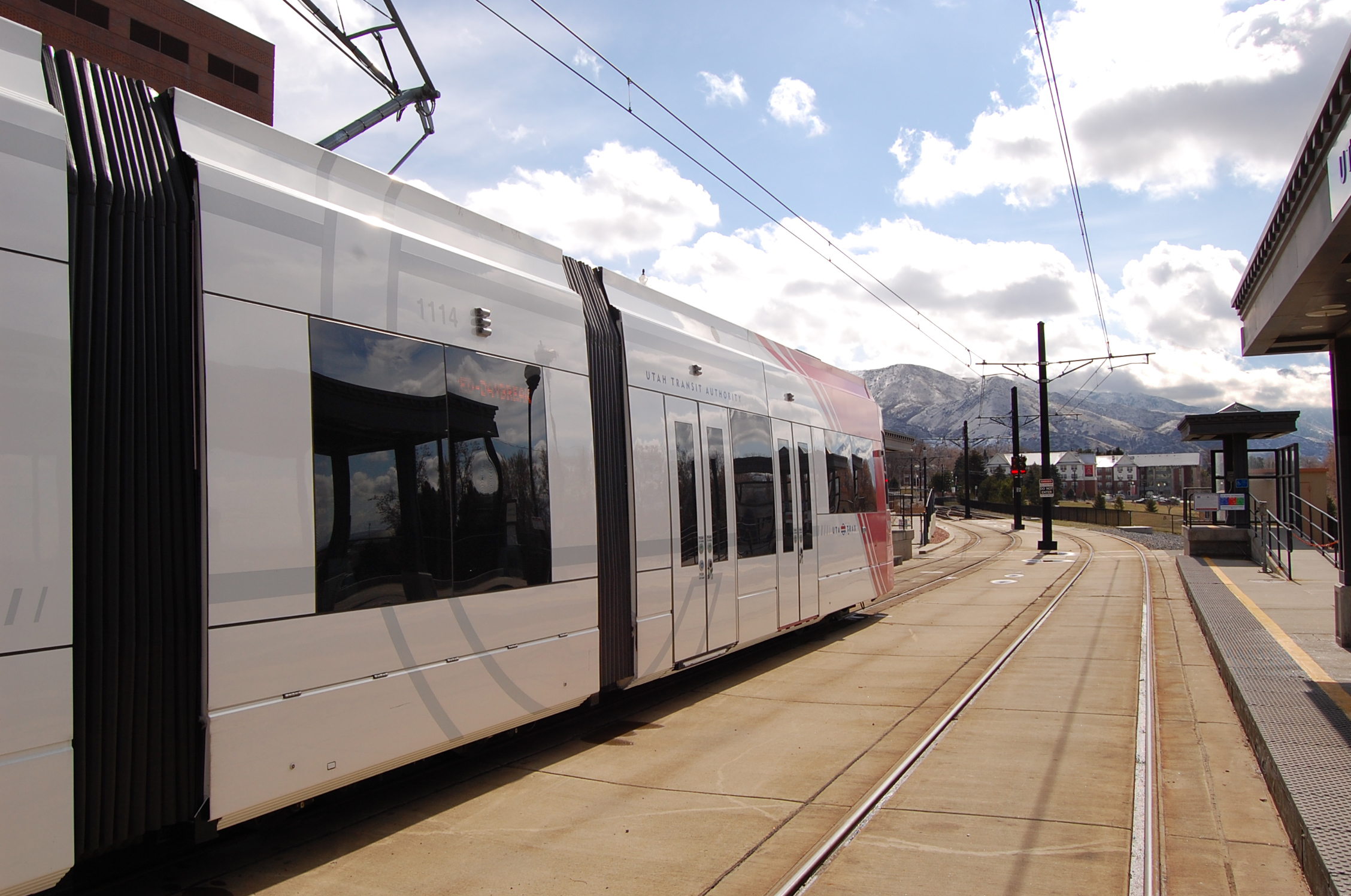
For the first time, researchers have shown that installing light rail on an existing travel corridor not only gets people out of their cars, but reduces congestion and air pollution.
In the study, planners at the University of Utah measured impacts of a new light rail line in Salt Lake City (University Line) on an existing major thoroughfare (400/500 South). Their analysis showed that traffic near the University has fallen to levels not seen since the 1980s, even as the number of students, faculty and staff at the university has increased, and the commercial district along the corridor has expanded.
"This is the first study to document important effects of light rail transit on traffic volumes,” said Reid Ewing, professor of city and metropolitan planning at the University of Utah and lead author on the study. “Since the University TRAX line opened, there has been increased development in the 400/500 South travel corridor, yet traffic on the street has actually declined. Our calculations show that without the University TRAX line, there would be at least 7,300 more cars per day on 400/500 South, and possibly as many as 21,700 additional cars. The line avoids gridlock, as well as saves an additional 13 tons of toxic air pollutants. This is important knowledge for shaping future transportation policies.”
Andrew Gruber, executive director of the Wasatch Front Regional Council, which has been responsible for coordinating transportation planning in the Salt Lake and Ogden areas since 1973 said, “This study further demonstrates the value of public transportation in helping people reach their destinations, reduce traffic and spur economic development. The findings are significant for local governments across our region as they consider the future of transit in their community.”
The report—which validates assumptions widely used in travel demand models used in community planning—was issued recently by the National Institute for Transportation and Communities, and has been accepted for publication in the Journal of Public Transportation later this year. The report is available for download at http://theotrec.org/project/611.
Ewing worked with Guang Tian, a doctoral student in city and metropolitan planning, and Allison Spain, academic program manager at the University of Utah.
Tags: development, emissions, guang tian, light-rail transit, nitc, reid ewing, traffic, traffic congestion, transit, university of utah, utah department of transportation, utah transit authority
Portland State University students enhance Tigard’s walkability

Several notable transportation projects have come out of Portland State University’s Master of Urban and Regional Planning (MURP) program this spring.
Each year, graduating students finish up their two-year program of study by forming into groups and carrying out a professional project. Clients work with Portland State University to identify planning needs that would be a good fit for the MURP program, and students choose projects based on their interests.
The Paradigm Planning team made news with their re-imagining of the Salem-Keizer transit system, and InSite Planning Group with their Beaverton corridor study.
The city of Tigard engaged StepUP Studio, another MURP team, to craft a pedestrian plan.
Tags: active transportation, livability, portland state university, research, walking
OTREC researchers will present on bike/ped counts at traffic data conference

OTREC researchers Krista Nordback and Sirisha Kothuri will present research at the North American Travel Monitoring Exposition and Conference (NATMEC) from June 29 to July 2, 2014.
The conference, organized by the Transportation Research Board, provides an opportunity for traffic monitoring professionals to share information about collecting and using traffic data.
Nordback will talk about what professionals can do to maintain bicycle count programs at the state level. She will give a presentation on the feasibility of using existing traffic signals to collect bicycle counts, and on what to do with that data once it is gathered.
Kothuri will present strategies for counting pedestrians using existing resources such as signal controllers and software already installed at intersections.
Nordback and Kothuri will draw from their own research as well as from the work of Miguel Figliozzi, Chris Monsere, Pam Johnson and Bryan Blanc in their ODOT report, Developing a Statewide Bicycle and Pedestrian Data Collection System in Oregon.
The conference, an international venue for sharing experiences on effectively monitoring traffic flow, will be held at Swissôtel in Chicago, Illinois.
Tags: active transportation, bicycle, bicycle infrastructure, otrec, research, transportation research board, walking
Student planning project yields professional results for Beaverton

Portland State University’s Master of Urban and Regional Planning (MURP) program matches students with clients every year to execute professional-level planning projects.
This spring, InSite Planning Group, a team of six MURP students, conducted a detailed corridor study for the city of Beaverton.
Tags: active transportation, livability, portland state university, research, walking
OTREC research helps Washington state track cycling and walking

When it comes to transportation investments, states have a good measure of automobile traffic to inform decisions: vehicle miles traveled. Bicycling and walking don't have a similar measure, leaving more guesswork in planning for those modes.
OTREC research associate Krista Nordback is helping to fix that disparity for Washington state. Working with graduate assistant Michael Sellinger, Nordback has published a research report presenting methods to estimate cycling and walking in the state.
The research is part of a larger effort, which includes Nordback's NITC research project, to create and apply pedestrian-miles-traveled and bicycle-miles-traveled -- PMT and BMT, resepectively -- measures at the state level. In the report, Nordback recommends improvements to Washington's Bicycle and Pedestrian Documentation Project and outlines how PMT and BMT could be estimated.
Washington already leads the nation in its nonmotorized count program, collecting bike and pedestrian counts in more than 30 cities across the state. The statewide focus of Nordback's project sets it apart from similar studies limited to the local or regional level.
The report identifies key needs for programs such as Washington's, including more counts in rural areas and the need to combine short-duration counts with permanent counters. It also found that using broad categories, such as region and urban versus rural, could be useful on a statewide level, despite being too general for local studies.
The report, which covers Phases 1 and 2 of the project, is available for download. More information on Phase 3, currently in progress, is at the NITC project page.
Tags: bicycle counts, bicycle miles traveled, count programs, krista nordback, pedestrian counts, pedestrian miles traveled, washington state dot
Archives
Categories
Filter By University
- Portland State University
- University of Oregon
- Oregon State University
- Oregon Institute of Technology
OTREC's Most Used Tags
active transportation alex bigazzi bicycle bicycle infrastructure bicycling chris monsere cycle tracks design electric vehicles emissions hau hagedorn hiring ibpi institute of transportation engineers jennifer dill john macarthur karen dixon kelly clifton livability livemove marc schlossberg metro miguel figliozzi nico larco nitc oregon department of transportation oregon institute of technology oregon transportation summit otrec portland state university proposals psu public transportation region x research rfp rita robert bertini step sustainable cities initiative transit transportation modeling transportation research board trb trimet university of oregon university of utah visiting scholar visiting scholars program walking